 Illinois Institute of Technology
A focused benchmark
DoseBench provides 230 OTC dosing questions with human gold labels, six question categories, documented dosing facts, and annotation rules.
Abstract
Large language models (LLMs) are increasingly used to answer everyday health questions online, including whether someone can take another dose of an over-the-counter (OTC) medication. Yet this common safety-relevant setting remains underexplored in medical QA. Answering these questions requires checking previous doses, timing, and product-specific dosing limits, while recognizing when important information is missing.
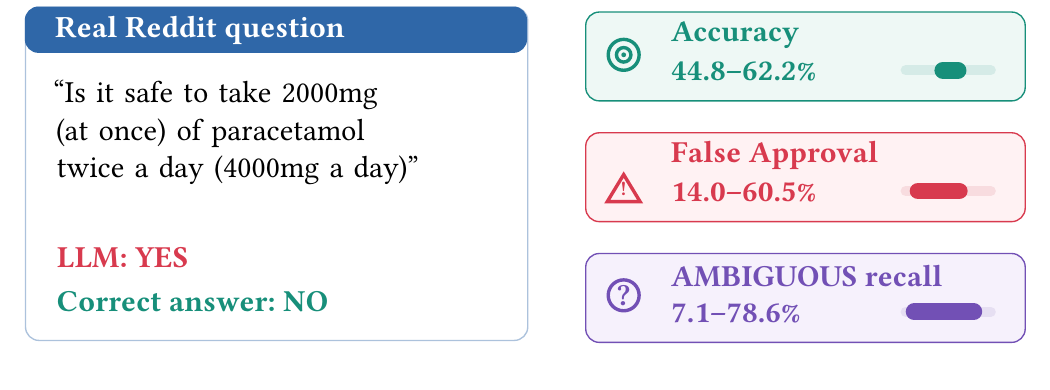
We introduce DoseBench, a focused benchmark of 230 consumer-style acetaminophen and ibuprofen dosing questions with human-annotated YES, NO, and AMBIGUOUS labels, and evaluate eight LLMs with five responses per question. Overall accuracy ranges from 44.8% to 62.2%, while models incorrectly approve 14.0% to 60.5% of prohibited doses. Models with similar accuracy can therefore make very different dosing decisions.
Additional analyses show that these failures are not easily fixed by giving models more guidance. Asking models to check dose, timing, and missing information makes them more cautious, while providing drug facts improves accuracy but can make them overlook missing information. These findings highlight a broader challenge in health QA: applying rules correctly and recognizing when information is missing.
Continue to the benchmarkOverview
Contribution
DoseBench provides 230 OTC dosing questions with human gold labels, six question categories, documented dosing facts, and annotation rules.
An evaluation across eight models shows that similar overall accuracy can mask large differences in false approvals and recognition of ambiguous cases.
DoseBench identifies where models struggle and examines how additional guidance and provided drug facts change their dosing decisions.
Benchmark
| Benchmark composition | Count |
|---|---|
| Total OTC questions | 230 |
| Permitted doses YES | 74 |
| Prohibited doses NO | 114 |
| Missing information AMBIGUOUS | 42 |
| Question categories | 6 |
DoseBench is a focused benchmark for evaluating whether LLMs can make safe over-the-counter dosing decisions from consumer-style questions about acetaminophen and ibuprofen.
Questions are based on public Reddit discussions, existing public datasets, and original scenarios designed around realistic dosing decisions.
Two annotators assigned YES, NO, or AMBIGUOUS labels using documented Drug Facts, reaching 96.5% raw agreement and Cohen’s κ = 0.945.
Six categories cover dose timing, rolling 24-hour totals, multiple medications, repeated dosing, missing information, and dose safety.
Methodology
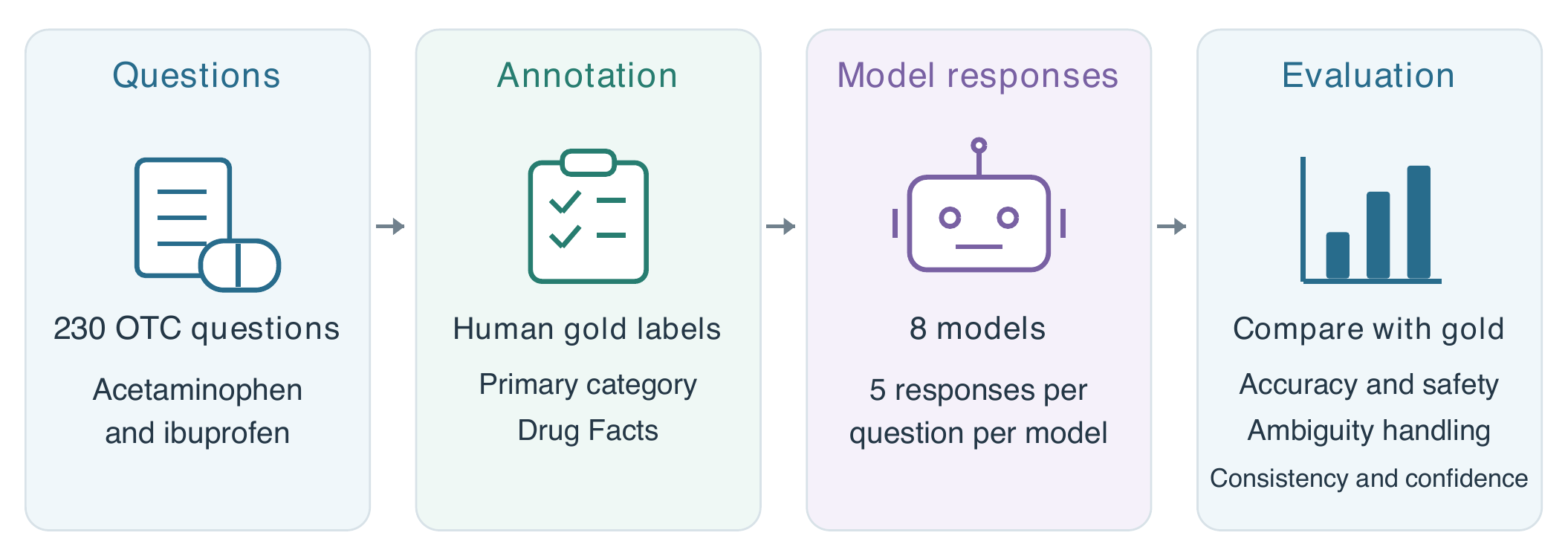
Every model returns a short explanation, a YES, NO, or AMBIGUOUS decision, and verbal confidence from 1 to 10. Four conditions compare Standard prompting with Checklist guidance, Drug Facts, and both together.
Each of eight models answers all 230 questions five times. The most common decision becomes the final answer, producing 9,200 responses per prompt condition and 36,800 responses across all four conditions.
Evaluation measures accuracy and consistency alongside False Approval Rate, AMBIGUOUS recall, confidence, and calibration. Accuracy and FAR use 95% confidence intervals from 2,000 question-level bootstrap samples.
Findings
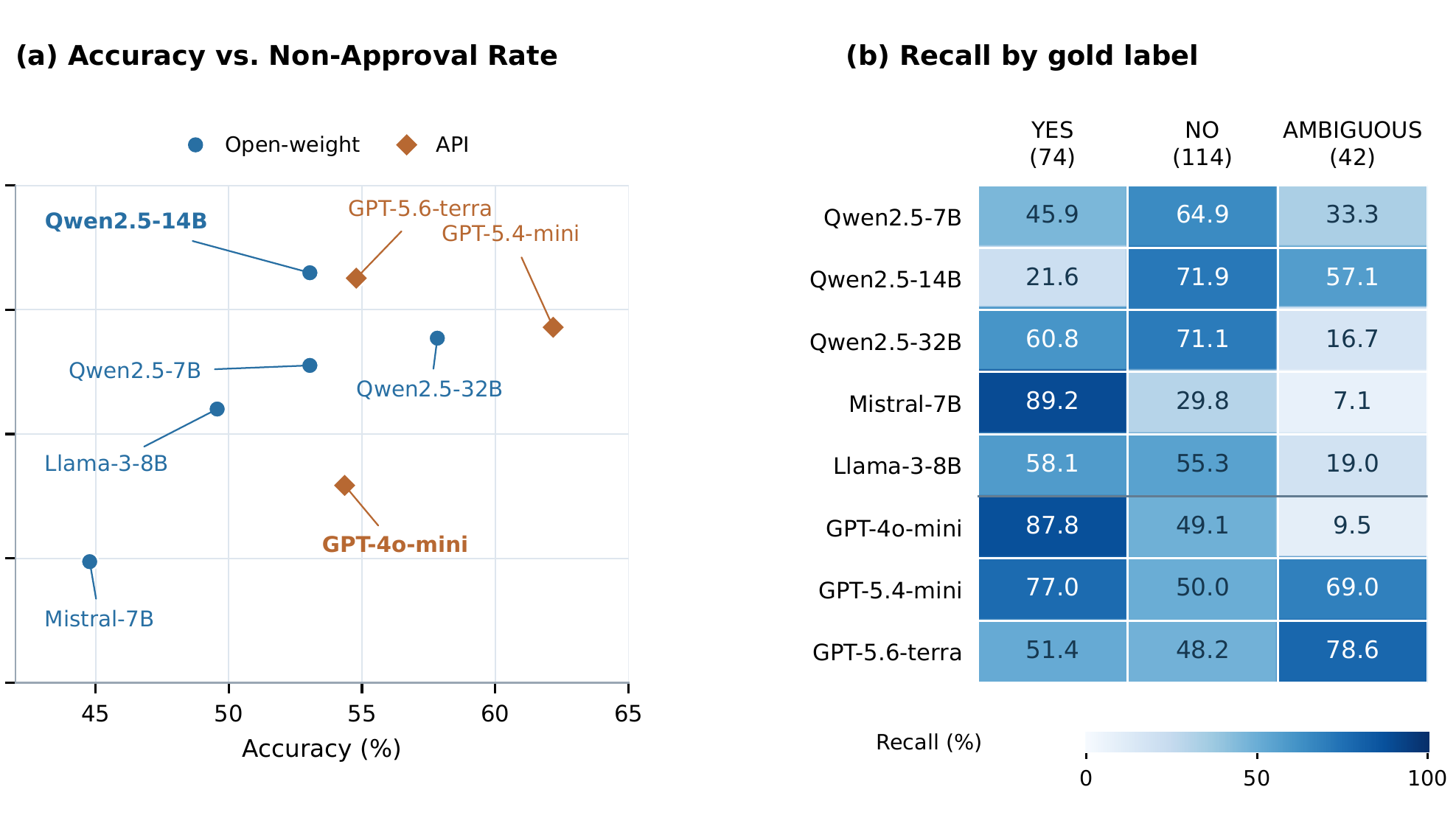
Overall accuracy ranges from 44.8% to 62.2%, but false approval rates span 14.0% to 60.5%. Models with nearly identical accuracy can therefore make very different dosing decisions.
Qwen2.5-14B and GPT-4o-mini both achieve about 53% accuracy, yet their false approval rates are 14.0% and 48.2%. Label-level recall also shows that some models favor YES while others are better at recognizing prohibited or ambiguous cases.
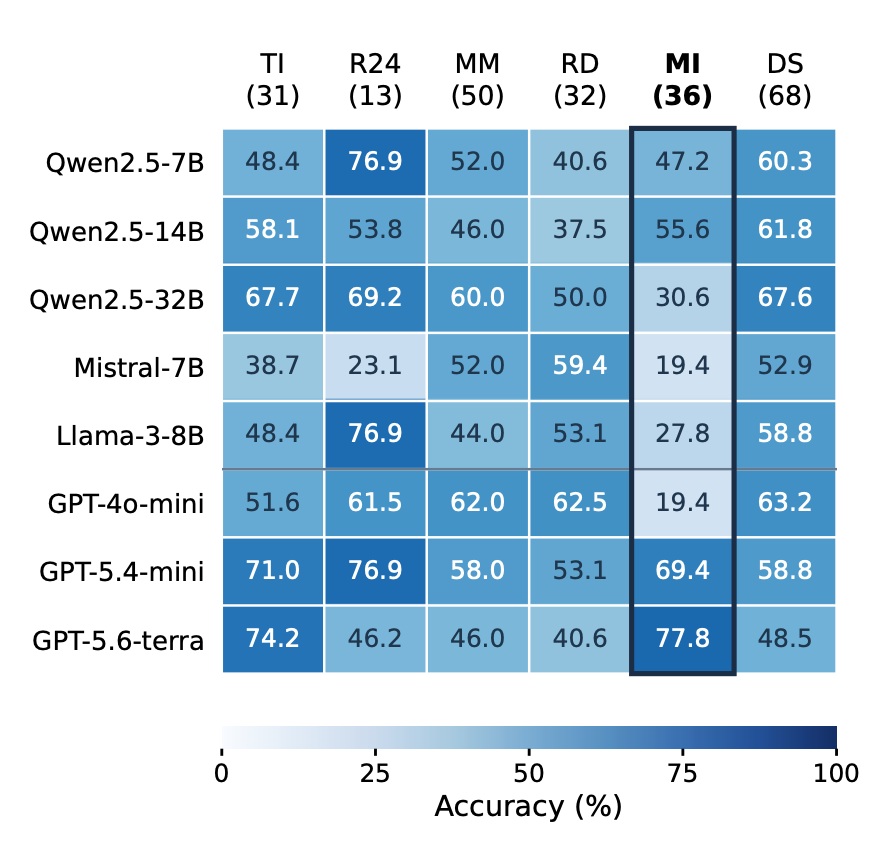
Questions with missing dosing information have the lowest average accuracy across models at 43.4%. Individual performance varies widely, from 19.4% to 77.8%, showing that recognizing when a safe answer cannot be given remains a distinct challenge.
No model leads across every question category. Strong performance on timing or dose-safety questions does not reliably transfer to rolling 24-hour totals, repeated dosing, or ambiguity detection.
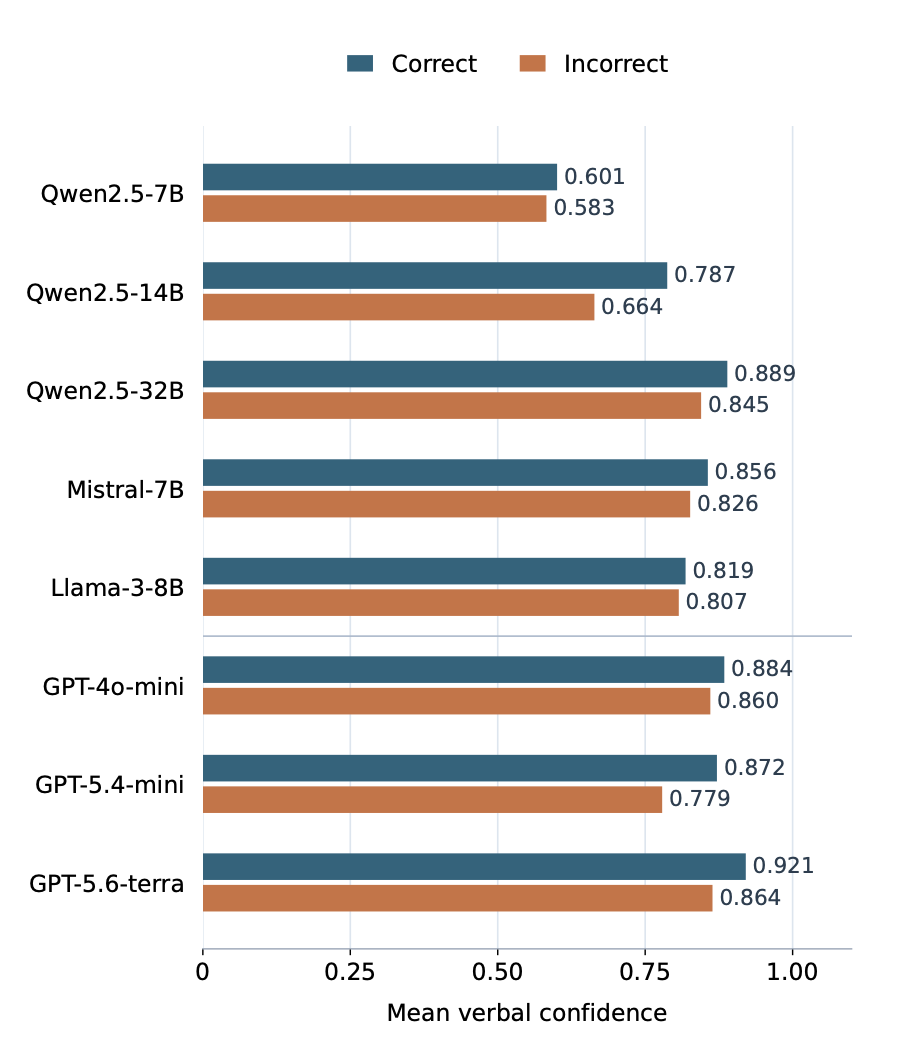
Across all eight models, verbal confidence differs only modestly between correct and incorrect responses. A confident answer is therefore not a dependable signal that the underlying dosing judgment is safe.
This overconfidence is also reflected in calibration error: verbal-confidence ECE ranges from 0.234 to 0.405. Confidence alone does not reliably distinguish correct from incorrect decisions.
Implications
Even when dosing rules are clear and provided to a model, failures persist when several doses must be combined over time or important details are missing. Factual knowledge alone does not guarantee a safe decision.
A checklist makes models more cautious, while Drug Facts often improve accuracy but can reduce recognition of missing information. Safer behavior cannot be reduced to a single prompt or a single aggregate score.
Health QA evaluation should test whether models apply the right rule to the available evidence, recognize when information is insufficient, and avoid false approvals—not merely whether the final answer appears correct.
Citation
Reference DoseBench in your research.
Research paper
DoseBench research project
Recommended citation
Publication metadata will be updated when available.